
Beyond the Handshake: Why the 4 Pillars of Professionalism Matter in Your Estate Sale
When you decide to sell an estate, a collection, or business assets, you’re looking for a partner to help manage your wealth.
At Farmer Auctions, we know that the peace of mind we promise our clients is built on four specific pillars: being Transparent, Licensed, Insured, and Bonded.
While it’s tempting to choose an auctioneer, or worse yet, an estate sale or “tag sale” company, based on a lower commission rate or a handshake deal, hiring an uncertified provider carries risks that can turn a profitable sale into a legal nightmare. Here’s why those four criteria are non-negotiable for your protection.
1. Transparency: The Key to Everything
Transparency is the backbone of every successful auction. When sellers and bidders clearly understand the process, expectations, rules, and results, confidence soars—and confident participants bid stronger and more often. A professional auction built on openness not only protects consumers, but it also elevates outcomes and preserves the integrity of the auction method of marketing. Transparency is the key because it ensures:
- Trust and Credibility: Clear terms, disclosures, and documentation assure both buyers and sellers that the process is honest, ethical, and professionally managed
- Competitive Bidding: When bidders have access to accurate information, they feel secure, placing confident bids, which drives true market value. Bids are received in a public facing sale format, not hidden on a hand-written ledger.
- Accountability: Licensed and bonded auction professionals provide verifiable records, firm timelines, and documented results. The sales results are public knowledge and provided to the seller in the form of a settlement statement.
- Fairness: Everyone operates under the same rules, sees the same information, and participates on a level playing field.
- Confidence in Outcomes: Transparent reporting and results protect sellers, satisfy bidders, and reinforce the reputation of the auction process.
In short, transparency isn’t just good practice, it is the foundation that allows the auction method to consistently deliver strong, fair, and market-driven results.
2. Licensed: The Mark of Professionalism
In the state of Virginia, being a licensed auctioneer is a legal requirement, but it’s also a badge of competency. A license ensures that the auction company:
- Knows the Law: They are well-versed in Virginia’s auction statutes, consumer protection laws, and tax requirements.
- Education: In Virginia, a licensed auctioneer’s education is a rigorous blend of legal, financial, and technical training. It begins with 80 hours of state-approved classroom instruction covering the Uniform Commercial Code, contract law, and asset valuation, followed by a comprehensive state examination. This ensures that every professional is not only a skilled “bid-caller” but also a competent fiduciary capable of navigating the complex regulations governing estate sales and consumer protection.
- To maintain their professional standing, auctioneers must complete mandatory continuing education every two years, keeping them sharp on evolving tax laws, cyber-security, and ethical standards. Many go even further, earning advanced designations like Certified Estate Specialist (CES) or Certified Auctioneers Institute (CAI)—the industry equivalent of a master's degree. This commitment to lifelong learning means that when you hire a licensed professional, you are gaining an expert partner who understands the legal weight of your assets as clearly as any attorney or accountant.
- Has Undergone Vetting: Licensed professionals often pass background checks and rigorous exams to prove they understand the ethical and logistical demands of the trade.
- Commits to Ethics: Maintaining a license requires adhering to a strict code of conduct. If a licensed auctioneer behaves unethically, they risk losing their livelihood.
Why it matters to you: An unlicensed provider is essentially "flying under the radar." If they mishandle your sale, you have very little recourse through official regulatory boards.
3. Insured: Protecting Your Property and Liability
Auctions involve movement—moving heavy furniture, high-value art, and crowds of people. Accidents, though rare with a professional team, can happen. A professional auction company carries General Liability and Workers’ Compensation insurance. What happens if the company isn't insured?
- Property Damage: If a mover drops your grandmother’s $5,000 mahogany sideboard, an uninsured company may not have the liquid capital to reimburse you.
- Personal Injury: If a bidder or staff member trips and falls on your property during a preview, you—the homeowner—could be held liable for their medical bills if the provider isn’t properly covered.
4. Bonded: Your Financial Safety Net
Bonding is perhaps the most misunderstood term in the industry, but it is the most critical for a seller’s financial security. An auctioneer bond is a form of consumer protection.
It is essentially a guarantee held by a third-party surety company. If the auctioneer fails to pay the seller their proceeds or mismanages the funds from the sale, the bond ensures that the seller is compensated.
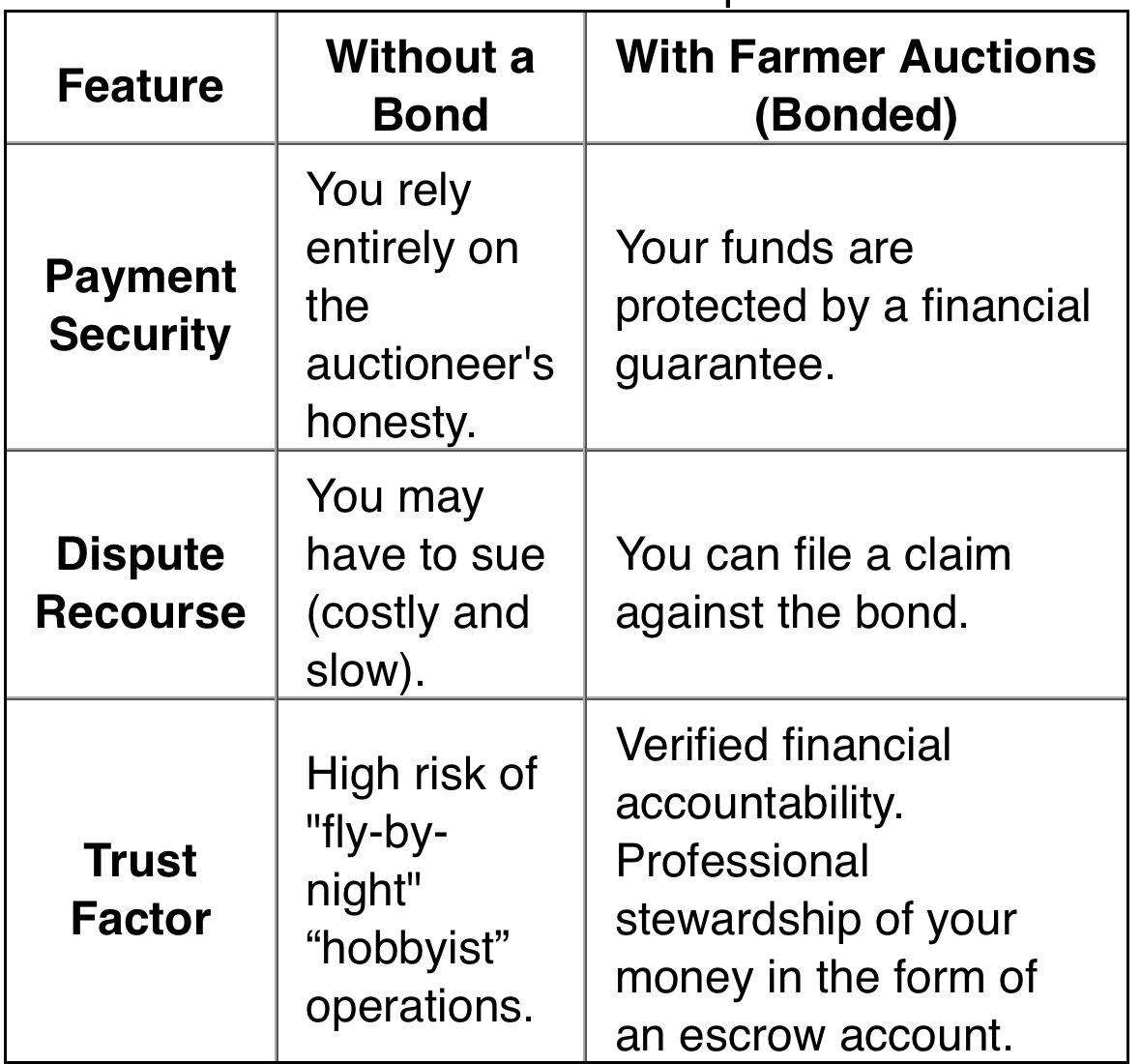
The Farmer Auctions Advantage
At Farmer Auctions, we don't just meet these requirements, we exceed them. We believe that transparency is the foundation of a successful auction. By maintaining our licenses, carrying robust insurance, and being fully bonded, we take the risk off your shoulders and put it onto ours. When you hire a professional team, you aren't just paying for a service; you are buying the certainty that your assets will be handled with integrity and that your check will clear.
Ready to start your auction journey? Whether you have a single high-value item or an entire estate to manage, we’re here to help. Contact Farmer Auctions today to speak with a licensed professional about how we can securely maximize the value of your property.